By: Jason Spars
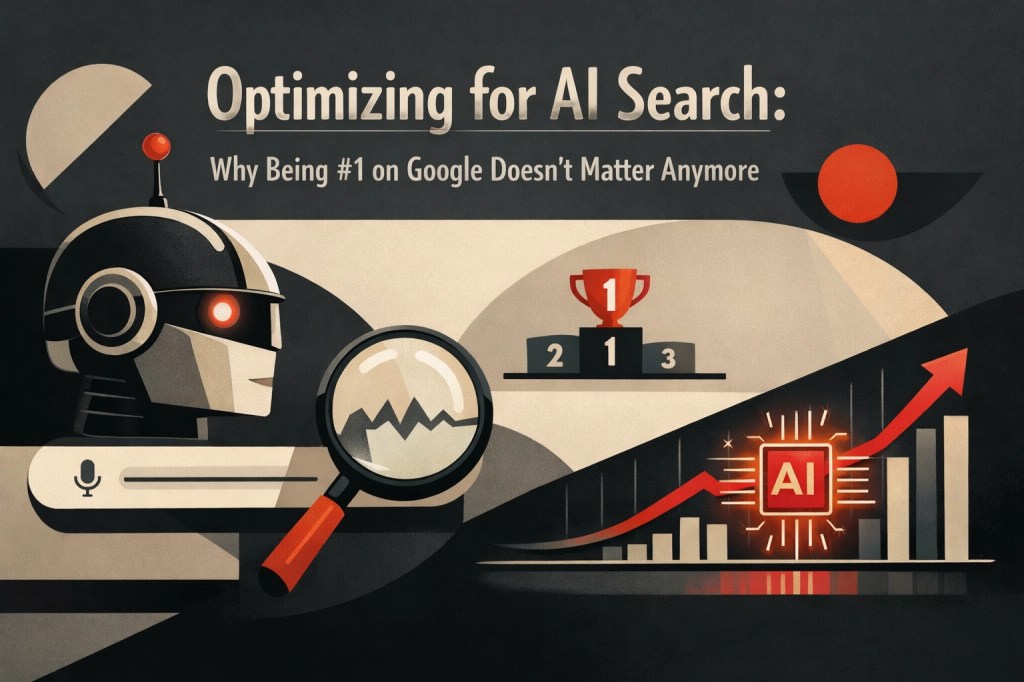
Stop obsessing over your Google ranking.
I know that sounds crazy coming from someone who’s spent years telling you to “optimize your website” and “target those keywords.” But here’s the reality: your potential clients aren’t using Google the way they used to. They’re asking ChatGPT “Who’s the best realtor in Lakeville?” or telling Gemini “Find me a buyer’s agent who specializes in first-time homebuyers in Minneapolis.”
And if you’re not showing up in those answers? You’re invisible.
The Search Revolution You Didn’t See Coming
Let’s get real for a second. AI Overviews are already reducing organic clicks on the top Google result by an average of 34.5%. That’s not a future prediction: that’s happening right now in February 2026.
Your $500/month SEO investment that got you to Page 1? It’s delivering diminishing returns because search behavior has fundamentally changed. Buyers and sellers don’t want a list of 10 blue links anymore. They want answers. Instantly. Synthesized. Without clicking through your beautifully optimized landing page.
Here’s what’s actually happening in your market:
- A buyer in Eagan opens ChatGPT and asks: “What neighborhoods have the best resale value near good schools?”
- A seller in Lakeville asks Perplexity: “Should I list my home now or wait until spring?”
- An investor in Hudson uses Gemini: “Who are the most knowledgeable commercial agents in St. Croix County?”
None of these searches are happening on Google. And none of them are generating clicks to your website: unless you’re the agent these AI systems cite as the authority.

Welcome to the Era of AI Citation
Here’s the shift you need to understand: Success is no longer about ranking for keywords. It’s about being cited by AI systems.
Think about it this way. When someone asked Google “best realtor near me,” you competed with 12 other agents on Page 1. Now when someone asks ChatGPT the same question, there’s typically one or two agents mentioned by name. That’s it. You either get the citation or you don’t.
The opportunity here is massive. Brands implementing Generative Engine Optimization (GEO) strategies are boosting their AI citations by over 150%. But most agents in Minnesota and Wisconsin? They’re still playing the old game, wondering why their website traffic is tanking.
SEO Is Dead. Long Live GEO.
Let me break down the difference between what used to work and what works now:
Old SEO Playbook:
- Write 2,000-word blog posts stuffed with keywords
- Build backlinks from random directories
- Focus on driving traffic to your website
- Measure success by Google ranking position
- Create comprehensive guides that cover everything
New GEO Playbook:
- Create structured, factual content that answers specific questions
- Demonstrate expertise through unique local insights
- Focus on getting cited as the source
- Measure success by AI brand mentions
- Update content continuously (recent beats comprehensive)
Here’s a truth bomb: ChatGPT prioritizes recent content over comprehensive content. That “Ultimate Guide to Buying a Home in Minnesota” you wrote in 2023? It’s being outranked by a mediocre article someone published last week.
How AI Systems Actually Choose Who to Cite
AI models don’t rank websites the way Google does. They’re looking for different signals entirely. To get cited, your content needs:
Clear structural hierarchy – Use descriptive H2 and H3 headers that directly answer questions. “What Are Closing Costs in Minnesota?” not “Understanding Your Investment.”
Direct, quotable answers – Give the answer in the first 2-3 sentences of each section. AI systems extract these as citations.
Unique local expertise – Generic advice gets ignored. Specific insights about Minnesota’s disclosure laws or Wisconsin’s time-share rules get cited.
E-E-A-T signals – Experience, Expertise, Authoritativeness, Trustworthiness. This means author bios, credentials, case studies, and specific examples from deals you’ve actually closed.
Multimodal content – Here’s something most agents are missing: AI systems now extract information from images, videos, and audio files. That video walkthrough of a Lake Minnetonka property? ChatGPT can “watch” it and cite you as the expert on lakefront homes.

Your GEO Action Plan for Minnesota & Wisconsin Markets
Stop theorizing and start implementing. Here’s exactly what you need to do this week:
1. Audit Your Digital Footprint
Search for yourself in ChatGPT, Gemini, and Perplexity using these exact queries:
- “Best real estate agent in [your city]”
- “Who specializes in [your niche] in [your area]”
- “What agent knows the most about [local neighborhood]”
If you’re not getting mentioned? You have work to do.
2. Create AI-Optimized FAQ Content
Build a content library that answers specific, local questions:
- “What’s the average time on market for homes in Woodbury right now?”
- “How do property taxes in Dakota County compare to Washington County?”
- “What are the most common issues found in home inspections in older Minneapolis homes?”
Make your answers factual, current (updated monthly), and specific. Include numbers, percentages, and dates.
3. Structure Your Website for AI Extraction
Your website needs to be “snippet-friendly”:
- Use schema markup for LocalBusiness and RealEstateAgent
- Create a dedicated FAQ page with structured data
- Add “Last Updated” dates to every piece of content
- Include your credentials and specific market experience in your bio
4. Leverage Multimodal Content
Record short video answers to common questions. AI systems are crawling YouTube and extracting information. A 2-minute video explaining “What First-Time Buyers Need to Know About Minnesota’s Down Payment Assistance Programs” can generate AI citations across multiple platforms.
5. Build Authority Through Unique Data
AI systems love citing unique research. Start publishing:
- Monthly market updates with specific neighborhood data
- Comparison analyses (suburbs vs. urban Minneapolis for families)
- First-hand case studies from your recent closings
Don’t just rehash MLS data. Add your analysis, predictions, and insights.

The Minnesota/Wisconsin Advantage
Here’s your competitive edge: Most national real estate content is generic garbage. When you provide hyper-local insights about Crystal, Edina, Hudson, or River Falls, you become the only citeable source.
Focus on questions that require local expertise:
- “How do Wisconsin’s real property transfer return requirements differ from Minnesota?”
- “What neighborhoods in the Twin Cities have the best ROI for rental properties?”
- “How is the new Minneapolis 2040 plan affecting property values?”
These questions can’t be answered by a generic Zillow blog post. They require someone who actually works these markets. That someone should be you.
Stop Waiting for Google to Send You Traffic
I challenge you to think differently about content creation. You’re not writing blog posts to rank on Google anymore. You’re creating a citeable knowledge base that AI systems recognize as authoritative.
This means:
- Publish more frequently (weekly minimum)
- Update existing content monthly
- Focus on specific questions, not broad topics
- Include recent examples and current data
- Create video, audio, and image content: not just text
The agents who adapt to this shift first will dominate the AI citation game. The agents who keep optimizing for “Google Page 1”? They’re going to wonder where all their leads went.

Your Next Steps
Don’t overcomplicate this. Start with three actions this week:
- Search for yourself in ChatGPT – See if you’re being cited for your market area
- Create one AI-optimized FAQ page – Answer 10 specific local questions with factual, current responses
- Update your most important content – Add current dates, recent statistics, and specific examples from 2026
The future of real estate marketing isn’t about being #1 on Google. It’s about being the answer AI systems trust enough to cite. And that’s a game you can win: if you start playing it now.
Want to talk strategy with agents who are already implementing GEO? Join us at KW Lakes where we’re building the systems that work in 2026, not 2020.
Because here’s the truth: A different result requires doing something different. And what worked last year won’t work this year.
Time to optimize for the search engines that actually matter.
 Lakes Coaching
Leave a comment